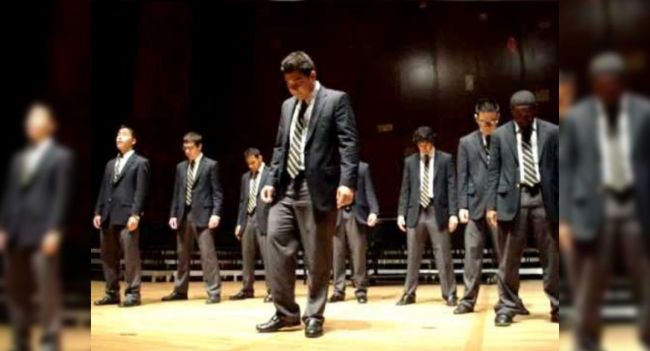
UC Berkeley Men’s Octet Takes on Queen’s ‘Bohemian Rhapsody’ in Extraordinary A Cappella Performance That Has Captivated Millions
Few songs present a greater challenge to vocal performers than Queen’s legendary “Bohemian Rhapsody.” With its sudden musical shifts, intricate harmonies, operatic passages, and explosive rock finale, the six-minute masterpiece demands an extraordinary level of musical coordination. Yet eight young men from the University of California Men’s Octet decided to take on the challenge — without a single musical instrument — and delivered a performance that continues to delight audiences years later.

Their rendition, presented at the Welcome Back to A Cappella Showcase at Berkeley’s Hertz Hall, has attracted more than 4.5 million views, introducing countless viewers to a creative interpretation of one of rock music’s most recognizable songs.
What makes the performance particularly entertaining is not simply the group’s vocal ability. The eight singers combine impressive harmonies with theatrical movements, playful expressions, and carefully timed gestures that follow the song’s dramatic progression.
Eight Singers, One Legendary Queen Classic

The University of California Men’s Octet has a long musical tradition. Established in 1948, the ensemble brings together some of the university’s most talented male singers.
Its repertoire covers an unusually broad range of styles, including contemporary pop, doo-wop, barbershop, and songs celebrating the Berkeley spirit.
That versatility makes Queen’s “Bohemian Rhapsody” an especially interesting choice. Originally recorded by Queen, the song is famous for refusing to follow conventional musical structures. It moves between intimate ballad passages, elaborate operatic sections, and powerful rock arrangements, creating a challenge even for experienced musicians.
The UC Men’s Octet approached the task by relying entirely on their voices and stage presence.

When the eight performers assembled onstage, they stood with their arms crossed, their heads bowed and their hands placed over their hearts. The audience had little indication of the elaborate vocal and theatrical performance that was about to unfold.
As they lifted their heads, the opening notes began, and the familiar introduction immediately drew the audience into the song.
Their ‘Freddie Mercury’ Takes Center Stage
One of the highlights comes during the ballad section, when a member of the ensemble steps forward to take the lead.
Serving as the group’s version of Freddie Mercury, he delivers the prominent vocal lines while the remaining singers provide the harmonies and supporting vocals behind him.

The arrangement gives each section room to develop while preserving the recognizable character of Queen’s original composition.
Rather than simply standing in a line and singing, the performers use coordinated movements to bring personality to the music. Their expressions and interactions add an entertaining visual dimension without distracting from the vocal work.
The result is an a cappella arrangement that feels both musically ambitious and wonderfully playful.
The Operatic Section Brings Out Their Theatrical Side
Then comes the section that makes “Bohemian Rhapsody” particularly distinctive.
As the song moves into its operatic passage, the eight men embrace the theatrical nature of the composition. Their gestures become more animated as they deliver the famously eccentric lyrics, including the memorable sequence:
“Galileo Figaro magnifico.”
The group’s exaggerated movements and synchronized reactions make this portion especially entertaining. Every transition brings a new visual moment, while the singers continue to maintain the vocal arrangement.
The audience clearly enjoys the performance, responding enthusiastically as the ensemble moves through the song’s increasingly dramatic sections.
At approximately the 3:40 mark, the arrangement takes another major turn as the music enters its rock segment.
A Rock Finale Without a Single Instrument

The energy in the room rises as the singers launch into the rock-and-roll portion of the song.
The audience erupts in cheers, and the performers respond by adding another playful touch: they mime playing electric guitars, recreating the visual excitement of a full rock band despite having no instruments onstage.
It is a clever way to capture the spirit of Queen’s music while staying true to the group’s a cappella format.
The contrast between their precise vocal harmonies and exaggerated rock-star movements gives the performance much of its charm. They are clearly having fun with the material, and that enjoyment becomes part of the experience for everyone watching.
Pulling off a song with so many musical changes is no small achievement. The Octet’s performance demonstrates how much can be accomplished through vocal arrangement, coordination, and a willingness to approach a familiar classic from a different perspective.
Why ‘Bohemian Rhapsody’ Continues to Captivate Generations

Originally released by Queen in 1975, “Bohemian Rhapsody” has become one of the most celebrated songs in rock history.
Its unusual structure and combination of musical styles helped distinguish it from conventional pop and rock recordings. Over the decades, it has continued to attract new listeners while inspiring musicians to experiment with their own interpretations.
The song’s legacy is reflected in the recognition it has received. It was inducted into the Grammy Hall of Fame in 2004 and has appeared on Rolling Stone’s prestigious “500 Greatest Songs of All Time” list.
It has also been recognized as the most-streamed song from the 20th century, reflecting its extraordinary staying power in an era when music is constantly being rediscovered by younger audiences.

Numerous performers have attempted their own versions of the Queen classic. Artists such as Jennifer Nettles have delivered memorable interpretations, while Marc Martel has attracted considerable attention for a voice frequently compared to Freddie Mercury’s.
Queen’s influence has also reached younger performers, with contestants on talent competitions such as The Voice Kids taking on songs including “Don’t Stop Me Now” and “Somebody to Love.”
The UC Berkeley Men’s Octet offers another example of how the band’s music can be reimagined without losing its original appeal.

Their performance is a reminder that a truly great song does not need an elaborate production to make an impression. Sometimes, eight voices, excellent timing, and a little theatrical flair are enough.

“Bohemian Rhapsody” remains one of the most challenging songs to perform, but these eight college singers make their version look like an absolute joy. Watch their remarkable a cappella performance below!