Civil War review – Alex Garland’s explosive thriller throws viewers straight into a fractured America
Alex Garland wastes no time easing audiences into Civil War.
From its opening moments, the 109-minute thriller drops viewers into a near-future United States already tearing itself apart, with abandoned attractions, wrecked infrastructure and the aftermath of violence scattered across the landscape.
It is an intense, unsettling vision of America in collapse — but rather than focusing on soldiers, Garland places journalists at the centre of the story.
And that choice gives the film its strongest emotional weight.
America is already at war
Garland, who wrote the screenplay for Danny Boyle’s 2002 film 28 Days Later, serves as both writer and director here.
Civil War is not structured like a traditional post-apocalyptic sci-fi story where viewers spend the opening act discovering how society collapsed.
The disaster has already happened.
The causes of the conflict are deliberately left only partly explained.
Through fragments of dialogue, audiences learn that the President, played by Nick Offerman, is serving a third term, has disbanded the FBI and has used military force against American citizens.
Texas and California have declared independence and joined forces, sending their armies towards Washington in an attempt to take control of the capital.
Garland does not spend much time explaining the politics behind that unlikely alliance.
Instead, the movie concentrates on what happens to ordinary people when the institutions around them have already broken down.
Four journalists race towards Washington
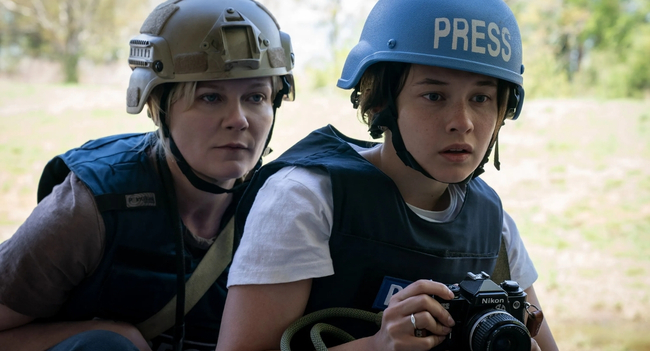
At the centre of the story is Lee, a veteran war photographer played by Kirsten Dunst.
After spending years documenting conflicts overseas, Lee has developed the emotional distance needed to photograph horrific events without allowing herself to become overwhelmed by them.
But this time, the devastation is happening at home.
She travels with reporter Joel, played by Wagner Moura, as the pair attempt to reach Washington before rebel forces arrive.
Their goal is extraordinary: secure one final interview with the President before his government falls.
The journey becomes more complicated when Joel brings two additional journalists along.
One is Jessie, played by Cailee Spaeny, an ambitious young photographer still learning what it really means to witness war at close range.
The other is veteran New York Times reporter Sammy, played by Stephen McKinley Henderson.
Together, they begin a dangerous 857-mile journey through a fractured America.
The road trip becomes increasingly terrifying
With major roads damaged or unusable, the group is forced through small towns and combat zones where the rules of normal life no longer apply.
Along the way, they embed themselves with rebel soldiers and witness increasingly disturbing examples of what the conflict has done to the country.
One of the film’s most tense sequences involves an encounter with a volatile soldier played by Jesse Plemons.
The scene strips away much of the spectacle surrounding the larger conflict and replaces it with something more immediate: four people trying to understand whether they will be allowed to leave alive.
That tension is central to Garland’s approach throughout the film.
The characters may travel through enormous military operations, but the danger often feels most frightening when it becomes personal.
Kirsten Dunst gives the film its emotional centre
Lee has spent decades training herself not to react.
Her job requires her to keep photographing while other people run away.
That detachment has allowed her to survive professionally, but watching similar destruction spread across her own country begins to affect her differently.
The relationship between Lee and Jessie becomes particularly important.
One is a journalist who has already seen too much.
The other is still discovering the adrenaline, fear and moral compromises that come with documenting conflict.
Dunst plays Lee as hardened and frequently difficult to warm to, but the emotional exhaustion underneath that exterior gradually becomes harder to ignore.
Her performance keeps the film grounded even when the scale of the violence grows.
The final battle takes the conflict to Washington
Civil War eventually reaches Washington for its largest action sequence.
The fighting moves through some of the most recognisable symbols of American political power as forces close in on the White House.
The scale becomes enormous, with soldiers pushing through the capital and landmarks caught in the destruction.
Yet the battle scenes never completely overwhelm the smaller human story.
Garland continually returns to the journalists and their determination to keep documenting events even when doing so puts them directly in danger.
That is what separates Civil War from a straightforward military action movie.
The explosions, gunfire and combat sequences are thrillingly staged, but they are always being observed through people whose job is to record what others would rather escape.
A war movie more interested in witnesses than politics
Some viewers may be frustrated that Garland refuses to fully explain how America reached this point.
The film provides enough information to establish the crisis but avoids constructing a detailed political history for the conflict.
That ambiguity appears deliberate.
Civil War is less concerned with explaining which side is ideologically correct than with imagining the experience of watching a familiar country become a battlefield.
Its most disturbing images are effective precisely because the locations feel recognisable.
This is not a distant fantasy world.
It is highways, stores, small towns and national landmarks transformed by conflict.
And by keeping journalists rather than soldiers at the centre, Garland turns the film into a story about witnessing catastrophe as much as surviving it.
Civil War is tense, visually striking and frequently uncomfortable, with Kirsten Dunst delivering a captivating performance at the centre of the chaos.