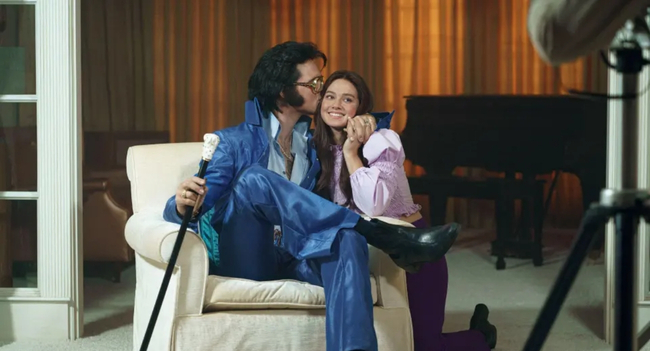
Priscilla Review: Sofia Coppola Turns the Presley Love Story Into a Beautiful but Suffocating Portrait
Sofia Coppola’s Priscilla approaches one of music history’s most famous relationships from a very different perspective, shifting the attention away from Elvis Presley and placing the young woman beside him firmly at the centre of the story.
Where Baz Luhrmann’s 2022 Elvis presented the couple’s meeting largely as a romance, Coppola focuses on a detail that changes how that beginning feels: Priscilla was a 14-year-old schoolgirl when she met Elvis, already a 24-year-old superstar.
That imbalance hangs over everything that follows.
The Presley story through Priscilla’s eyes
The film begins in 1959 at a US military base in Germany.
Priscilla, played by Cailee Spaeny, is introduced sitting alone in a diner, drinking a milkshake and doing her homework. She is young, isolated and clearly lonely.
Then a middle-aged man approaches her about attending one of Elvis Presley’s parties.
Priscilla explains her age and says her father would never allow it. The man responds that he will handle her father.
From there, Coppola begins examining a relationship that the film deliberately allows to feel uncomfortable.
Rather than reducing the story to a simple battle between hero and villain, however, the director leaves room for its contradictions and complexities.
Jacob Elordi’s Elvis is portrayed as someone who is himself controlled by the people around him, particularly his manager and father. He is trapped by the extraordinary machinery of his own success.
But eventually, Priscilla becomes trapped too.
Graceland becomes a beautiful cage
Once Priscilla enters Elvis’s world, glamour does not necessarily mean freedom.
Her life at Graceland is luxurious, but increasingly lonely and restrictive. Elvis disappears for stretches of time, wants to shape how she looks and leaves her without friends her own age to confide in.
It is territory that suits Coppola particularly well.
Through films including The Virgin Suicides, Marie Antoinette and Lost in Translation, the director has repeatedly explored intelligent young women surrounded by beauty and privilege while simultaneously confined by them.
Priscilla fits naturally into that tradition.
Graceland may look like a dream from the outside, but Coppola gradually reveals how suffocating that dream can become.
Cailee Spaeny delivers a near-perfect performance
The film’s greatest strength is Spaeny.
She convincingly carries Priscilla from an inexperienced teenager into a harder, more self-assured woman, allowing the transformation to emerge gradually rather than announcing it.
As Elvis changes from an infatuated boyfriend into an unfaithful husband, Priscilla changes with him.
Her posture becomes firmer. Her expression hardens. The girl introduced quietly drinking a milkshake begins to find a strength of her own.
Spaeny makes every stage of that evolution believable.
Coppola’s decision to tell this famous relationship from Priscilla’s perspective ultimately gives the story its power. Rather than another celebration of the superstar at its centre, Priscilla becomes a portrait of the young woman living inside his enormous shadow — surrounded by glamour, yet increasingly searching for a way to become herself.