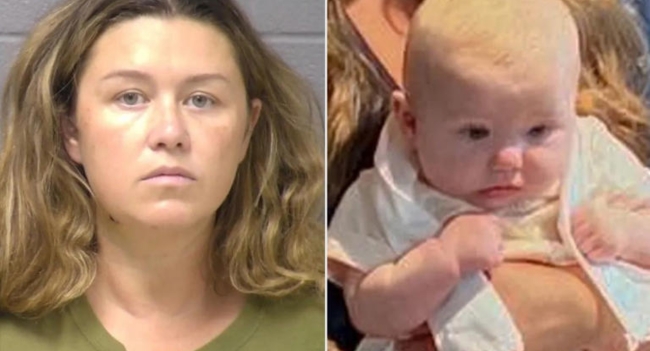
New Court Filing Reveals Cause of Death of 2-Year-Old Barrett Walsh as Mother Faces Murder Charges
A newly filed criminal complaint has disclosed how 2-year-old Barrett Walsh died inside his family’s Frankfort, Illinois, home—a development that adds further significance to a series of frantic messages his mother allegedly sent only hours before the child was discovered.
Barrett’s mother, Corie Walsh, 40, has been charged with three counts of first-degree murder following the September 1 incident. Court records available as of September 14 did not indicate that she had entered a plea.
According to the complaint, Barrett died from asphyxia caused by ligature compression of the neck.
The medical finding has emerged as prosecutors and defense attorneys examine Corie’s behavior leading up to her son’s death, including her reported fixation on the closely followed murder trial of Massachusetts mother Lindsay Clancy.
Neighbor discovered Barrett inside the family home
Court documents state that a neighbor entered the Walsh residence and found Barrett in the basement with a ligature around his neck.
The neighbor immediately contacted emergency services and attempted to perform CPR. Prosecutors said in a petition seeking to deny Corie pretrial release that the boy did not have a pulse.
Corie was also found inside the residence. Authorities allege that she was attempting to harm herself with a knife at the time.
Two of her older, school-age children arrived home around the time Barrett was discovered. An infant was also inside the house. Police said all three children were unharmed.
Barrett, affectionately known as “Bear,” was the third of Corie’s four children.
Messages about Lindsay Clancy case sent hours earlier
Investigators and attorneys are also reviewing messages Corie allegedly sent shortly before the discovery.
The messages concerned the trial of Lindsay Clancy, a Massachusetts mother whose case attracted widespread attention because of questions involving postpartum psychosis and her mental condition at the time of her children’s deaths.
According to Corie’s attorney, Robert Kerr, witnesses described her behavior during the hours before Barrett’s death as dramatically out of character.
While discussing the Clancy case in a group conversation, Corie reportedly became increasingly distressed.
“It was manslaughter, please help I’m really freaking out,” she allegedly wrote, according to witness accounts presented in court.
Corie also reportedly claimed that Clancy’s husband was responsible for the deaths of his children. That allegation reflected a conspiracy theory that Clancy’s own attorney has firmly rejected as false.
The timing and content of the messages have become part of the broader timeline now being considered by investigators and both sides of the criminal case.
Defense focuses on alleged mental-health crisis
:max_bytes(150000):strip_icc():focal(749x0:751x2)/corie-walsh-091026-b06679a94ee546fc8b86222e03e1d90a.jpg)
Kerr has argued that Corie’s psychological condition will be central to understanding the events inside the Walsh home.
During a recent court appearance, the defense attorney said Corie had been experiencing severe mental illness and suffered a “brief psychotic disorder” at the time of Barrett’s death.
Witness accounts describing an abrupt and significant change in her behavior shortly before the incident were also raised in court. Kerr later declined to comment further about the case.
The defense’s statements represent its position and have not been established as findings by the court.
Prosecutors, meanwhile, are proceeding with three first-degree murder counts. The available online court records did not provide information about a plea as of September 14.
Newly disclosed finding adds to developing case
The cause of Barrett’s death provides another important piece of evidence as authorities reconstruct the events of September 1.
The neighbor’s discovery, the presence of Corie and her three unharmed children inside or near the home, and the messages allegedly sent about the Clancy trial in the preceding hours are all expected to remain significant as the case moves forward.
Corie’s next court appearance is scheduled for September 24.
As the legal proceedings continue, the newly released complaint has placed renewed focus on the hours immediately before Barrett was found—and on whether Corie’s reported behavior and messages offer insight into her mental state at the time.