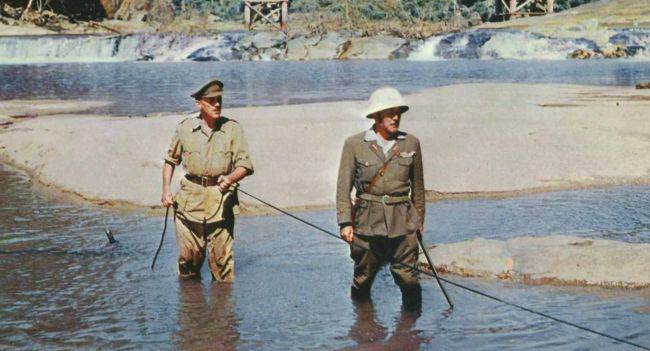
Seven-Oscar WWII Masterpiece Still Hailed as One of the Greatest War Films Ever Made

Nearly seven decades after its release, a British war epic starring Alec Guinness and William Holden continues to earn extraordinary praise, with viewers describing it as an unforgettable cinematic masterpiece.
Released in 1957, The Bridge on the River Kwai won seven Academy Awards, including Best Picture, Best Director and Best Actor. Its powerful exploration of duty, pride and the psychological consequences of war has helped establish it as one of cinema’s most celebrated classics.
The film holds a 96% critics’ score and a 93% audience score on Rotten Tomatoes, reflecting its enduring reputation among critics and moviegoers.
A Dangerous Struggle Inside a Japanese Prison Camp

Set during the Second World War, the story follows British prisoners of war held in Japanese-occupied territory and ordered to construct a railway bridge.
Colonel Nicholson, portrayed by Alec Guinness, initially clashes with the Japanese camp commander over the treatment of British officers and the rules governing prisoner labour.
What begins as a confrontation over military discipline gradually develops into a far more complicated struggle involving leadership, national pride and personal obsession.
As the prisoners work on the bridge, Nicholson becomes increasingly determined to demonstrate the competence and resilience of his men.
Meanwhile, a separate Allied operation introduces another dangerous objective, creating a conflict that threatens to bring the characters’ competing priorities into direct collision.
Rather than presenting a conventional story of battlefield heroism, the film explores how war can distort judgement and turn seemingly honourable intentions into destructive decisions.
David Lean’s Ambitious Adaptation
Directed by acclaimed British filmmaker David Lean, the film was adapted from Pierre Boulle’s novel The Bridge over the River Kwai.
Its impressive ensemble cast includes William Holden, Alec Guinness and Jack Hawkins, alongside Sessue Hayakawa, who delivers a memorable performance as the Japanese camp commander.
The production combines expansive location photography with intimate character drama, creating a story that is both visually spectacular and psychologically complex.
Lean’s direction places particular emphasis on the shifting relationships between captors and prisoners, exploring the uneasy boundaries between obedience, resistance and collaboration.
The result is a war film in which personal convictions and moral contradictions become just as important as military objectives.
Seven Oscars and International Recognition

The Bridge on the River Kwai became the highest-grossing film of 1957 and went on to dominate the following Academy Awards ceremony.
It received seven Oscars, winning in the following categories.
-
Best Picture
-
Best Director – David Lean
-
Best Actor – Alec Guinness
-
Best Adapted Screenplay
-
Best Cinematography
-
Best Film Editing
-
Best Original Score
The film also secured three Golden Globe Awards, including Best Motion Picture – Drama, and four BAFTA Awards, including Best Film and Best British Film.
Its cultural significance was further recognised in 1997 when it was selected for preservation in the United States National Film Registry.
Audiences Continue to Call It a Masterpiece

Decades after its original release, the film remains a favourite among viewers who appreciate classic war cinema.
One Rotten Tomatoes reviewer described it as the finest war movie they had ever watched, praising its storytelling and emotional impact.
Another called the production an absolute masterpiece, while other admirers highlighted its ambitious scale, exceptional acting and memorable screenplay.
Particular praise has been directed towards Alec Guinness’s portrayal of Colonel Nicholson, whose complex personality drives much of the film’s dramatic tension.
Some viewers have compared the depth of the characterisation to Shakespearean drama, arguing that the film’s moral conflicts remain remarkably sophisticated even by modern standards.
Why This War Classic Remains Essential Viewing

Although the film features military operations and the dangers of captivity, its greatest strength lies in its examination of human behaviour under extreme pressure.
Colonel Nicholson’s determination to preserve discipline and dignity raises uncomfortable questions about the relationship between pride and responsibility.
The film also explores the consequences of unquestioning loyalty, the meaning of military honour and the difficulty of distinguishing personal ambition from genuine duty.
Its combination of large-scale filmmaking, psychological suspense and powerful performances has allowed it to remain relevant to successive generations of viewers.
For audiences who enjoy war films built around moral dilemmas rather than action alone, The Bridge on the River Kwai remains an outstanding example of the genre.
The Oscar-winning classic is available to buy or rent through selected digital platforms, subject to regional availability.