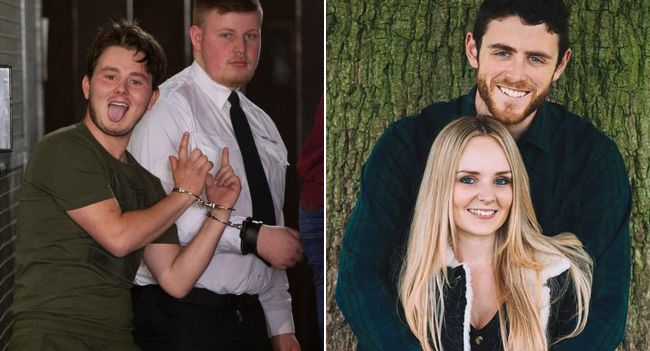
Albert Bowers has spent years behind bars for his role in the death of PC Andrew Harper — but a prison source claims the convicted killer has shown little sign of remorse, describing him as a man who appeared to treat the death of the young police officer as a source of status.
“That image of him laughing as he was being taken off to jail perfectly sums him up,” the source said. “He is a horrible, horrible individual.
“If it was up to me, he would never be allowed out because he is always going to be a danger. He will kill again at some point in his life when he is eventually released. I’m sure of that.”
Bowers is serving his sentence at HMP Frankland, where he quickly attracted attention among fellow inmates.

The high-security prison provides him with his own cell, including a television, toilet and wash basin. He also has access to computer games and an in-cell telephone, although the people he is permitted to contact are subject to security checks. Packages from Amazon are also regularly sent to him by family and friends.
But according to the prison source, Bowers arrived with an attitude that set him apart from most prisoners.
“Most inmates just want a quiet life, do their time with as little hassle as possible, and get out,” the source said.
“When Bowers first arrived at Frankland he acted as though he was king of the wing because he killed a policeman.
“To be honest, he wore his [PC Harper’s] death almost like a medal. He thought that would give him huge status.”

The source said Bowers is physically imposing and capable of fighting, but quickly discovered that prison status can disappear when challenged by someone more dangerous.
“He’s a big lad and is handy with his fists, but in prison, especially in Frankland, you are always going to come up against someone who is tougher, more violent or doesn’t care about the consequences.”
According to the source, Bowers was eventually confronted by another prisoner serving a life sentence for murder.
“Bowers immediately backed down, which revealed to everyone that he was mostly mouth and made himself quite vulnerable.”
The source claimed that Bowers is now protected by members of the travelling community inside the prison.
“But he is now protected by some very nasty travellers. I’m not even sure they like him that much, but there is a sense of loyalty among the traveller community.”
The same source described Bowers as “a really nasty piece of work” and alleged that he was “completely devoid of any morals or any humanity.”
A stark contrast with PC Harper

The descriptions of Bowers stand in stark contrast to the picture of PC Harper presented by his family, friends and colleagues.
Andrew Harper was just 28 when he was killed in the line of duty. Affectionately known as “Harps”, he was remembered as a devoted family man and a quiet country boy who loved the outdoors, wildlife and spending time with those closest to him.
He had married his childhood sweetheart, Lissie, only four weeks before his death. The couple had been together since they were teenagers.
On their wedding day, Harper gave his bride a card containing the words: “Life is slippery. Here, take my hand.”
Later that day, the newlyweds cut their wedding cake beneath a sign reading: “Happily ever Harper.”
At his funeral, his widow described the journey from the “sweet, lanky, red-faced boy passing me notes in class” to the “strong and loyal man” he had become.

Harper was also remembered for his kindness and his efforts to raise money for children with cancer.
His death came after he responded to reports of a quad bike theft near Sulhamstead, Berkshire, in September 2019.
Bowers and his co-defendants had links to the Four Houses Corner travellers’ site at Ufton Nervet, around eight miles from Reading. Bowers had left school when he was six and was unable to read or write. He supported himself through theft, particularly the stealing of quad bikes and farm machinery, while also working periodically as a landscape gardener.
The vehicle involved in Harper’s death was traced to the traveller site, leading to the initial arrest of 10 men.
Police later complained that their investigation had been hindered by a lack of cooperation from people within the travelling community. Items believed to have connected Bowers and the other defendants to the crime were reportedly burned.
The courtroom scenes that shocked the public
Bowers also attracted widespread condemnation during the legal proceedings.
Footage from an early court appearance at Reading Magistrates’ Court, just a month after Harper’s death, showed Bowers and others behaving in a seemingly carefree manner.
It was during that period that the infamous photograph was taken of Bowers sticking out his tongue and making V-signs towards onlookers, despite being handcuffed.
During the trial, the jury was shown distressing footage of Harper being dragged behind a vehicle to his death.
At one point, Bowers fell asleep while the footage was being shown.
The defendants were ultimately cleared of murder but convicted of lesser offences connected with Harper’s death. When the verdicts were delivered, the three men could be seen on a video link from HMP Belmarsh backslapping one another and celebrating.
Their reaction was reportedly echoed in the public gallery, where supporters cheered.
The scenes caused further anger among Harper’s family and supporters.
After the trial, members of Harper’s family called for the Four Houses Corner site to be dismantled. Residents and police had also raised concerns about the site and the behaviour of some of its occupants.
Despite those objections, Four Houses Corner later received a £4.2 million taxpayer-funded redevelopment from Liberal Democrat-controlled West Berkshire Council.
The council defended the decision, saying it had a legal responsibility to provide traveller accommodation and that no specific concerns about the management of the site had been raised directly since it reopened.
A sentence that has continued to cause anger
At the conclusion of the trial, Mr Justice Edis acknowledged the devastating impact of Harper’s death on his family.
“Nothing I can do, or could have done if there had been a conviction for murder, can restore Andrew Harper to his loving wife and family,” he said.
The judge added that Harper’s loss would remain with his family forever and expressed the court’s “profound sympathy” to them.
He also said he had carefully read the victim personal statements and listened closely to what had been said during the proceedings.
For Harper’s family, however, the question of whether the sentences adequately reflected the circumstances of his death has never disappeared.
Bowers’ early release was subsequently blocked, meaning he will remain behind bars for longer than originally expected.
Had his release not been stopped, he could have returned to the community as early as October 1, when the first tranche of 4,500 prisoners was due to be released under the government’s early-release programme. That group includes violent offenders, domestic abusers and stalkers.
Instead, Bowers is expected to remain in prison until around March 2029, when he and co-defendant Jessie Cole will have served two-thirds of their sentences.
For those who remember PC Harper as the young officer who had only recently married the woman he loved, that date remains a difficult prospect.
The question that continues to hang over the case is whether the punishment ever truly reflected the devastating loss of a 28-year-old police officer whose life was cut short while serving the public.
For Harper’s loved ones, the answer is unlikely to be found simply in the length of a prison sentence.