
“Time Is a Flat Circle”: Why Matthew McConaughey’s Deeply Haunted Turn in ‘True Detective’ Remains a Masterpiece of Television
Before he stepped into the shoes of Louisiana State Police Detective Rustin “Rust” Cohle, the world largely knew Matthew McConaughey as a charismatic, sun-drenched romantic comedy lead. Then came 2014.
In the landscape of modern television, few performances have managed to completely upend a Hollywood star’s career trajectory while setting an unreachable golden standard for the entire true-crime genre. When HBO aired the first season of Nic Pizzolatto’s anthology crime drama True Detective, audiences weren’t just treated to a gripping murder mystery—they were introduced to a brooding, brilliant, and completely unhinged force of nature named Rust Cohle.
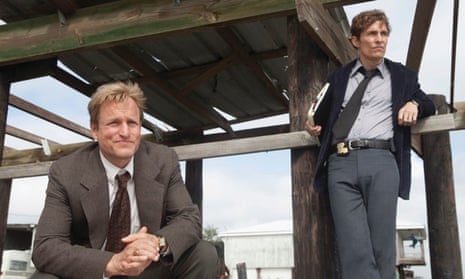
Spanning a complex, non-linear 17-year timeline from 1995 to 2012, the story tracks Cohle and his deeply flawed partner, Martin “Marty” Hart (played in brilliant, explosive counterweight by Woody Harrelson), as they hunt a sadistic serial killer with occult ties in rural Louisiana. Yet, more than a decade after its premiere, viewers don’t return to the show just to see the case solved; they return to submerge themselves back into the dark, poetic mind of McConaughey’s character.

The Metamorphosis: From Rom-Com Icon to King of Philosophical Nihilism
To fully appreciate why this performance stunned millions, one has to remember the context of its release. McConaughey completely transformed his physical appearance, voice, and mannerisms to play Cohle. Armed with a heavy ledger that earned him the nickname “The Taxman,” a constant stream of Camel cigarettes, and a thousand-yard stare that could freeze a room, he breathed life into one of television’s most iconic antiheroes.
Cohle is a man permanently hollowed out by an unimaginable personal tragedy—the accidental death of his young daughter, which subsequently destroyed his marriage and sent him spiraling through years of dangerous, drug-fueled undercover narcotics work. This trauma birthed a deeply pessimistic worldview, rooted in pessimistic nihilism, antinatalism, and a cold dismissal of religion and human ego.
                              [THE MIND OF RUST COHLE]
                                         │
                  ┌──────────────────────┴──────────────────────┐
                  ▼                                             ▼
       【 The Traumatic Catalyst 】                  【 The Philosophical Outlook 】
       - Death of his infant daughter.              - Deeply committed pessimistic nihilist.
       - Collapse of his marriage.                  - Views human consciousness as a tragic error.
       - Years spent in undercover narcotics.       - Proclaims that "Time is a flat circle."
Instead of coming across as entirely unlikable or cartoonishly bleak, McConaughey injected Cohle with a hypnotic, heartbreaking vulnerability. Whether he is expertly manipulating a suspect in an interrogation room or delivering a gravelly monologue in the front seat of a police cruiser, his performance makes even the most disturbing existential ideas impossible to look away from.
“To think that everything repeats… that past, present, and future exist simultaneously. It’s an eerie, Lovecraftian nightmare, yet strangely beautiful.”
Why Season 1 Stands Alone as a Crime Drama Masterpiece
True Detective Season 1 didn’t just succeed on star power alone; it was a perfect storm of narrative structure, chemistry, and suffocating atmosphere:
-
The Chemistry: The friction between Rust’s philosophical detachment and Marty’s traditionalist, hyper-masculine hypocrisy creates an incredible dramatic tension. They are partners, rivals, and at times, direct enemies, yet their shared obsession binds them together over two decades.
-
The Atmosphere: Under the brilliant direction of Cary Joji Fukunaga, rural Louisiana acts as a living character. The endless swamps, desolate coastal highways, industrial ruins, and abandoned churches create a gothic, oppressive landscape that feels like a fever dream.
-
The Legendary Monologues: Scenes like the “Time is a flat circle” speech became instant pop-culture milestones. The terrifying notion that mankind is trapped in an eternal loop of living its failures and suffering over and over again redefined what a television cop could talk about.
:max_bytes(150000):strip_icc()/true-detective-1-b66e6055510847a2b0ada8ba0f82bf50.jpg)
Ultimately, what prevents the series from collapsing under its own heavy darkness is its final, unexpected destination. After years of drowning in grief and confronting the worst of humanity, Rust Cohle experiences a tiny, fragile fracture of spiritual breakthrough in the final scene. It is a story that walks you through an atmospheric nightmare, only to leave you with a profound, tear-inducing meditation on hope. If you have never experienced it—or if it’s simply time for your annual rewatch—grab a drink, dim the lights, and prepare to watch a masterclass in acting.