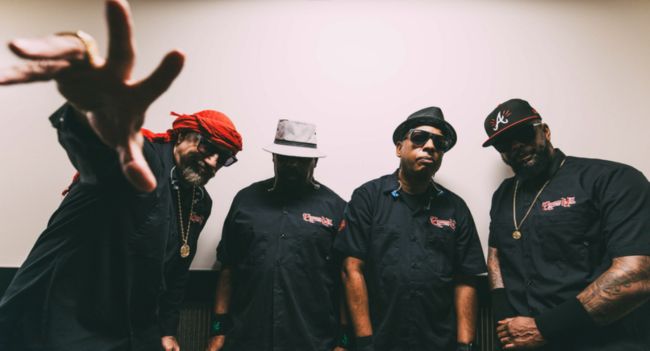
Cypress Hill’s B-Real Talks Celebrating Cultural Pride and Spirituality on ‘Dios Bendiga’ LP

Though he’s known for his laconic aura, B-Real is visibly excited. It’s a July afternoon in the dog days of summer, and despite the humid weather, the Cypress Hill member is riding high. However, the veteran lyricist’s lifted vibes can’t be attributed only to cannabis fumes. Last week, the 56-year-old and his groupmates released their eleventh studio album, Dios Bendiga, a body of work that doubles as a creative achievement and homage to their cultural roots. It marks Cypress Hill‘s first full-length Spanish-language album since their 1999 compilation Los Grandes Exitos En Español, which saw B-Real, Sen Dog, DJ Muggs, and Eric Bobo recording their greatest hits and fan favorites in their ethnic tongue.
Released amid a growing wave of Latino artists dominating the music charts, Los Grandes Exitos En Español was B-Real and crew bridging the gap between their audience of English and Spanish-speaking fans. The trend was one Cypress Hill themselves helped set with their double-platinum certified debut album in 1991. Yet, Dios Bendiga is also a show of civic pride and solidarity with fellow Latinos in light of sociopolitical efforts to criminalize, marginalize, and deport illegal immigrants, many of whom hail from Latin countries and have built a life for themselves in America.
“This was our stance,” B-Real tells VIBE when asked of the revolutionary overtone of Spanish hip-hop in recent times. “Taking up the stance at this time when you have ICE fucking with people all over the place, and immigration is all over the place. We’re doing a Spanish album, letting you know that we stand with these folks, ‘cause we are these folks. I think any community that’s come out of struggle can relate to one another.”
He continued, “It sort of helps band us together in certain ways because we can relate to each other’s struggles one way or another. I think that’s what ties it all together. This is us standing on ours and speaking our minds and educating people and lighting them up and entertaining them as well.” Recorded in late 2025, what initially was slated as a quick-strike project was extended past that deadline, a pivot B-Real is adamant was key to the curation and musicality of Dios Bendiga.
“We work fast,” the Los Angeles native said of he and his groupmates, who kicked off the Dios Bendiga sessions with the album’s opening track “Wacha Trucha.” “We’re not dudes who drag ass in the studio. We get in there, and we work, but we’re also realistic with ourselves. If the shit ain’t got the goods, then we put it to the side and go to the next. You can’t put an album together in two weeks. We’re going to need a month to two months. That’s what we took and just fine-tuned it throughout.”
That intention and dedication to the art has served Cypress Hill well throughout their decades-long career, as the group has built a legacy as pioneers and trailblazers while continuing to break barriers, creatively, professionally, and personally.
You and the group recently released your album Dios Bendiga. How has the reception been so far?
B-Real:
It’s been good. We didn’t anticipate the love we’ve been getting because it’s been like 30 years since we released a Spanish record.
It’s been incredibly positive. It’s all original songs. It’s not like the last one, where it was a translation of our existing songs that were our bigger pieces. This one was all original.
This is your first full-length album in Spanish in decades. What led to the decision?
We know throughout our history, we built a bunch of different fan bases, from our hip-hop base to alternative punk and metal, but we also have a very strong Latin base of Spanish-speaking fans.
And when we popped it off with the Los Grandes Exitos En Español record, we sort of lit it up for Latin fans out there who enjoyed hip-hop and got a chance to hear it in their language. It was important for us to get back to it and give our Latin fans, our Spanish-speaking Latin fans, something that they’ve asked us for a long time. Plus, as artists, we like a challenge. We know that since we dropped that 30-some-odd years ago, now there is a robust culture of Spanish hip-hop.
There have been a lot of emcees, styles, and lyrics. This has evolved throughout that time, and now the game is filled with a lot of great talent out there. So it’s competing with that, too. We like to challenge ourselves to see how we snap in with all these newer hip-hop artists out there that are killing it. They’re spitting bars. That was the motivation. A promise to our fans and challenging ourselves as artists.
Who are some of the artists rapping in Spanish who are on your radar?
Santa Fe Klan is a really dope guy. We tried to have him on the album, but his schedule was crazy. Alemán, who I’ve had a chance to work with a few times. We got him on the record ’cause he is crazy with the bars.
Yusak from La Santa Grifa is another one. There are so many out there right now who are spitting and fucking fire in Spanish. American styles, American cadences, but with a Spanish flip on it. It’s incredible to hear these guys doing that shit because, primarily, we used to just hear dudes flipping the Spanish raps on reggaeton. But now you’re hearing it on dope ass hip-hop beats.
And I love reggaeton, but there is a culture of real MCs that get down on this hip-hop shit. I’ve been afforded a chance to go around the world for many years and hear the different talents that pop up in different places, and when we get a chance to work with some of these guys who we think are the shit and we respect, it’s great. That’s why Trueno coming on, I thought he was really dope. I had a chance to work with them on something that he was doing, and he had bars.
I’ve seen growth from that time 30 years ago to now in how the MCs have evolved. I listen, and the ones who catch my ear, who I think are really spitting that shit, those are the guys I want to get down with. Those are the guys I want to be creative with and do collaborations with ’cause iron sharpens iron.
We’re in a historic era for Latin rap. How does it feel to see the seeds that you and others plant blossom after all these years?
It’s great to see that. It’s great to know that we were a part of it. Think about it like this. It was us and Control Machete that sort of pioneered it in the early days in terms of Spanish rap shit. And for us to be an American-based group … I mean, we’re all of Latin culture. Sen Dog was originally born in Cuba, but migrated over to the States early on in his life at 5. Eric Bobo, who was Puerto Rican, Latino, Nuyorican, and Muggs, he’s Italian and all that, but they’re practically Latin to us. We have had that, but we’re from America. To know that an American-based hip-hop group, we’re a part of putting the seeds out for Spanish rap, that’s history in itself. Control Machete was right there with us, doing their thing, and they’re pioneers in it as well. Now, you’ve got an influx of many dope artists.
I’ll be honest, there are some shitty artists, too, but that’s in English and Spanish. Any language. It’s the yin and yang of artistry. Some are really dope, and some aren’t so great. That’s the reality of it.
But the guys that we’ve been hearing as of late are really fucking great, from the trap side of it in Spanish. Fucking crazy bars. The freestyle, battle rap shit. Motherfuckers got bars and the songwriting. Like really writing dope hip-hop songs. Some guys are killing it out there. It’s incredible to see and to have been a part of the beginning is an honor.
This is also Cypress Hill’s first full-length project in over four years. What was the reason for the hiatus?
We do a lot of road work, man. What a lot of people don’t realize, and I think even new artists don’t realize, is that when you put out records, you tend to tour off those records for a long time until someone from the label or your management says, “Hey, we’ve got to put out a new fucking record.” Back when we were on Sony, you were on a schedule so you put out a record, you supported that record, and you toured. It was mostly like a two-and-a-half-year span, and then they want you to get back in the studio to pop off another record.
We were very used to that format when we were on a major label with Sony. When you flip, and you go to an independent style, you realize that once you’ve built your base, you don’t necessarily have to put out as many records as the record company would like you to because they’re just following their momentum.
What happens is that when you’re not on the hook, and you don’t have a schedule like that, you tend to do more road work. You go on tour, do shows, and run your catalog, and get people familiar with it if they’re not. You win people over who might not know who you are. Appease your fan base and shit like that.
Sometimes when you’re on the road like that, you tend to lose track of time creatively. Like, “Oh shit, we’ve been doing road work for like two or three years, and we haven’t put anything out. We need to fucking get in the studio.” So, for us, it was like that.
We had put out Elephants on Acid and Back in Black within close proximity of each other in terms of Cypress Hill. Elephants on Acid was produced by DJ Muggs, our brother, bandmate, and original producer. Then, we did Back in Black with Black Milk, which was a collaborative thing.
After that, we got on the road, and we started working. We didn’t necessarily tour off those albums. We just did what we normally do and placed a couple of songs from both those records in our set. And then we were probably up to year three or four, and we were like, “Fuck, we need to make some new music.” At first, the thought was to make another Skull & Bones-type of album, like half hip-hop and then half metal.
That was actually the marching order that we were going to try to execute. Then, somebody came to us and said, “You guys have been talking about this Spanish record for so long. Why don’t we do that? We can do the Skull & Bones type of shit later.” We were all like, “Yeah, why not? Let’s do it.”
We had this little bit of time to get in the studio and put down some ideas, and from those ideas came the songs, and we just got into creative mode. But that was it. We had spent so much time on the road that it was time for another piece.
We’re of the thought that at this point, we’re the type of band that can tour with or without a record. So it’s not necessarily the need to put out a record to sell tickets or anything like that, ’cause I think our shows stand on their own. When people come to see Cypress Hill, they know they’re getting a fucking intense fucking great quality show ’cause we put 100% into that.
It’s kind of like The Grateful Dead. The Grateful Dead could tour. If you’re not familiar with them, they’re an old-school rock band. Jazzy rock type of shit. Anyway, they had stopped putting out records, and they were just touring based on their old catalog, and people showed up for them, and we’re at that point that people show up for us no matter what ’cause they love the catalog and they know we come and run the show.

So, we didn’t necessarily need to do the music we wanted to. That was the big deal, and I think that’s why we had fun doing it, why it came to us so easily, and sounds the way it sounds. I think that was the big difference between other records that we’ve done in the past.
What’s the translation of “dios bendiga” in English?
“God bless.” “God bless us.”
Why did you choose that as the album title?
I felt it was a blessing to have that opportunity to do that record. To be in the position that we’re in at this point, and people would want that record. At this point, people could have forgotten about us and been like, “They’ve been around for 30-some-odd years. They had their run,” and been indifferent about what the fuck we’re doing, but there was excitement.
I’m a very spiritual human being, so I felt like it was a blessing from God to bring this opportunity and to give me the ability to do it. The first [Spanish] album, Grand Exitos, I only wrote maybe two songs in Spanish ’cause I wasn’t really well versed in it. I mean, I knew how to do it, but I wasn’t great at it like Sick Jacken or Mello Man Ace was.
So, Sick Jacken and Mellow wrote most of the translations on that first Spanish album, but from then to now, I had been working on my Spanish writing. Doing features with other artists and even penning some of my own shit that I had in the [vault] to maybe put out later on some Spanish shit. So, I was kind of warming up to this already.
When the opportunity came for us to do this album, the time and the platform and whatnot, God must have blessed me because before, I was very insecure about my pen game in the Spanish lane. When we started working on this, I felt an ease that I never felt before writing in Spanish. I felt like I could go anywhere, and yeah, it felt different. It didn’t feel like me in there.
It felt like something was flowing through me. So that’s why “God bless.” God blessed me with that shit ’cause, trust, I really was always questioning my ability in that. So for it to have come out the way it came out, God blessed us. So that was the theme of the album. In terms of the album cover, we’re just always trying to be out of the box and have it be something that people fucking be wowed by or question. That’s always the Cypress Hill thing.
You mentioned somebody came to you all and was like, “We can hold off on the half-metal and half-rap album and do the Spanish thing.” Who was that person?
I think it was Eric Bobo, our percussionist, drummer, and music director, to be honest with you. We all listen to a lot of shit. We all vibe out to what’s going on out there, and we’ve got our ears to the streets in all these different ways. He came at it like, “We’ve got that base, right. We’ve fed that base, and we’ve done things for it. Right now, people are calling for us to do this shit and we should do this. We could always do that later.” We’re always open-minded to each other’s ideas. No one’s ever closed off.
We’re very open, and when he mentioned that, we’re like, “Shit, let’s pivot,” ’cause we can always do that later. It’s not something that we’re on the hook by a label to turn something in at a certain point. It’s when we want to turn it in. It’s when we want to fucking put it out. That’s why the pivot was so easy.
Speaking of Eric Bobo, he worked with DJ Flict, who handled the production on the album, and DJ Lord. Can you speak on how they crafted this album from a sonic standpoint?
Flict, Bobo, and myself were in the studio together every day and Flict and Bobo would get there before me because I got The Dr. Greenthumb Show that I was running.
Well, we still run it, but at that point, I was running it early so that I could get off the broadcast and get straight to the studio. They would be there already, and Flict would pop up a beat Bobo would play on top of it whether it was drum kit or electronic drums or his percussion and it’s really the first album that we’ve done that where Bobo’s playing underneath everything and being a part of that creative process and and Flict man he just like Bobo and I have been working with Flict for a while and and he’s been a fan of Cypress Hill for a very long time.
So as friends, he knows us, and as a fan, he understands what the band is and what it means. His thoughts about what we should sound like right now, and not trying to borrow from the old shit, but take it to a new place.
So he was always in that thought process, and Bobo was always right there with him. You know when we finished recording, you know, all the songs we’re like, we need Lord on a lot of these pieces ’cause he will fill in the space. I mean, Lord makes the turntable an instrument like nothing. You know what I mean?
I’ve been blessed to have some of the best DJs running the set for Cypress Hill and for myself, and I’ve got to say, Lord is one of the best. His ability to cut shit on tracks and be in that certain pocket where it elevates the track — he’s got that. He brought that to the table on all the songs. He just took it to another level.
I feel like a lot of people have left the turntables behind in their music, and one thing we try to do is elevate and highlight the turntablism. It was important to get Lord on these tracks. What we did differently, that most groups don’t do, was we had sounds that were in the key of the songs. I would say none of them do it. This was our first time doing it. So that when Lord cut, it was in the key of whatever the key of the song was, as opposed to just getting random samples that don’t match up or that we had to pay for, even if he’s cutting them. It was a pretty revolutionary idea by Lord and Flict because Flict was a turntablist at one time. Before, he was a producer, too.
He thought it would be dope to give Lord some sounds that would be in key of the songs. Nobody does that, and it ended up incredible. Salute to Flict, Lord, and Bobo for being on one with the music. They made it easy for sending out and the rest who featured on it with us to come and do what we did.
Can you list the features on the album?
Yeah, we got the legendary Mellow Man Ace on “Campeones,” which was awesome to have Mellow on the record with his brother Sen Dog. It’s been long overdue, and it was the perfect backdrop. Salute to Mellow.
Sick Jacken of the Psycho Realm, which I was formally a member of, is featured on two. He is one of the best in Spanish rap shit, man. He is a gun slinger. I’ve got to tell you, he’s top five, straight the fuck up. He featured on “No Tengo Miedo” and “Voló,” and he fucking massacred both of them.
We had Coyote. [Ricky] Blanco and [Ladies Love] Guapo, a couple of bros from Hawthorne, California, Chicanos, proficient in both languages in their bar work. They killed it. Guapo was on two songs. He was on “Sueños” and “El Perro Y El Coyote,” and his brother Blanco was on “Sueños” as well. There’s also Trueno on “Saca La Bolsita,” Yusak of La Santa Grifa on “Barrios Prendidos.” Poe Leos on “Run,” which is one of my favorite joints. And Alemán on “Wacha Trucha.” Those are pretty much all the features we got.
What would you say is the most memorable moment from the recording sessions that kind of stuck with you?
I think it was the first day when the first song that we worked on, “Wacha Trucha,” came out, and we were surprised that … like when you make a song, when you got it off top. It’s just a feeling everybody has. You’ll see it on everybody’s face, and everybody’s moving to it.
If you don’t have it, you’ll see questionable faces, and you might question it yourself. You might say, “Well, it’s pretty good, but we might have to come back to this. Let’s move on to the next shit.” You’re doing framework at that point. You’re not like when you’re in there in the beginning; you’re not necessarily finishing every song the day of. You’re just sort of like laying them down, and then you come back to them, and you start fucking with them.

Off of the first song, we’re like, “Oh shit. This just might be something,” ’cause we were very excited on the first day of how the first song came out. That was very memorable because that shit set the tone for every day after that first day. Every time Flict, Bobo, and I work together, it starts off with the fucking shot of tequila. Then we smoke big fat ass joints. We talk about fucking bullshit, and then we get to the creative side of it, and then the shit just comes to life. That’s what we did that first day. It was a real easy thing, no pressure. I don’t know if I’ve ever had a fucking studio session that was that easy on the first day doing a project.
That shit stood out to me. There wasn’t any wild or crazy shit ’cause we were about the work, but that feeling that we got that first day, I’ll never forget that.
You’ve described this album as a “prayer for the culture.” Do you think that prayer will be answered?
Listen, with prayers it’s tricky. You can ask for something, and if it’s a good thing and if it’s meant for you, it’ll come. It’ll manifest. It’s all about manifestation. You talk about the shit you want to see, the shit you want to do, the shit you want to have, the shit you want to accomplish, you know? You could pray for it, but you’ve got to work towards that.
You can’t just pray for something and expect it to happen. You have to put work towards that. Like, if it’s for me, I got to work for it. And if I’m going to have it, I’ve got to put the work in, and possibly I’ll receive the reward from this. If it doesn’t happen, then it wasn’t meant for me. That’s how prayer works.

The Best Wireless Headphones for Audiophiles
We review the best wireless headphones based on sound quality, connectivity, battery life and comfort. Here are four to buy online.
Like some people lose faith when they pray for something and they don’t get it, don’t realize maybe what they’re praying for wasn’t for them. You have to have that realization, and if you don’t, you’ll never understand it, and you start losing and lacking faith. I prayed for things that were for me, and I prayed for things that weren’t for me, and then when those didn’t come, I realized how ridiculous I was praying for certain shit like that. You know what I mean?
It’s just like that. Faith is a strong thing, man. If you have it, you have it; if you don’t, you don’t, and sometimes your faith will get tested even if you do. When I pray, I know that it can happen, but I know that I’m going to have to do some work, and other people who believe in that have to do work for it, too. That’s just the fact.
Do you have any plans to tour for this album?
We have a Latin American tour planned for November. We’re going back into Mexico the following year to play some shows based on this album, and we’re going to try to do those sets more on the Spanish side.
We’ve done a lot of the Spanish songs going over there here and there during the course of our careers, but we’ve played mostly English sets. This now gives us an opportunity to play this new shit if they’re feeling it like that, which it seems like they are. We could present this particular set and then add on our old shit as encore, bonus type shit.
We’re planning to do some different shit. I mean, we’re going to play our old heaters, too, but we’re trying to really go in with this Spanish shit because we’re getting that reaction from Latin America. Like, “Oh fuck, we want them to come perform this shit over here.” So we’re taking that seriously.
What’s next for B-Real and Cypress Hill?
I stay recording. Just before we released this album, I released an album [This Thing of Ours] with Xzibit and Demrick as Serial Killers.
Later on in the year, I’ll be releasing one with my man Berner. It will be our fifth project. I’m just constantly working. I fucking put out a record with Psycho Les [Real Psycho] last year, and we’ll probably be working on something in the future.
But most importantly, after this Spanish shit, after we do our run with this, our next studio focus is to go in and do that Skull and Bones type of record, where it’s half metal, half hip-hop. That’s pretty much the next piece.
In between that, it’s touring and hitting all these different places again and introducing them to the new shit, the Spanish shit, and doing that particular run.
Would you say we’ll have to wait another four years?
Hell no. We’ve already talked about it and said, “Look, we’re going to run this album for a year, and then we’re going to go straight to the next one, and start recording that. Start getting the ideas down and recording hat.” So, it should not be a four-year run.
SOURCE: ROLLINGSTONE