Congratulations!
You've earned 1 point
THE SAFE-DEPOSIT KEY
PART 1
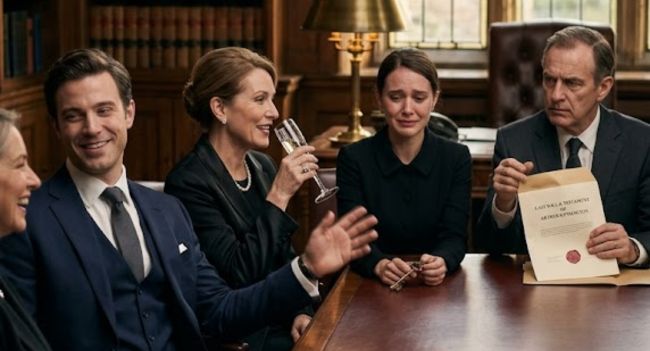
😢 The first thing my stepbrother did after the lawyer announced I had inherited only an old brass key was laugh and toss it across the table.
It struck the polished wood once, spun in a crooked circle, and stopped beside my hand.
Jason leaned back in his chair, straightening the cuffs of the navy suit our grandfather had paid for.
“The cheapest inheritance in Carter family history,” he said.
My stepmother, Linda, covered her smile with one manicured hand. My father stared down at the papers in front of him, pretending he had not heard. Across the conference room, two of my cousins exchanged glances before one of them snorted into his coffee.
Nobody asked what the key opened.
Nobody noticed that Mr. Bellamy, my grandfather’s attorney, had not closed the leather folder resting in front of him.
I picked up the key.
It was heavier than it looked. Tarnished around the edges, warm where Jason’s fingers had touched it, with the number 317 engraved into one side.
I turned it over in my palm.
For three years, my family had called me a thief.
For six months, they had waited for my grandfather to die.
And for less than thirty seconds, they believed they had won.
Then Mr. Bellamy removed one final envelope from the folder.
“Before anyone signs the distribution documents,” he said, “there is an additional instruction from Mr. Carter.”
Jason’s smile faded.
Mr. Bellamy looked directly at me.
“Emily, your grandfather requested that you keep that key with you at all times.”
The room went silent.
Not because anyone suddenly respected me.
Because they had finally realized the key might open something.
My grandfather, Henry Carter, was the first person who ever made me believe that being quiet did not mean being weak.
When I was nine, he took me to a construction site on the edge of town. Carter Construction was still small then—three trucks, one rented excavator, and a portable office that smelled like coffee and wet lumber.
Grandpa put a yellow hard hat on my head. It slipped over my eyes.
“You see that foundation?” he asked, pointing toward a rectangle of poured concrete.
I pushed the hat back. “Yes.”
“Most people only notice a building after the walls go up. But the foundation is what decides whether the whole thing stands.”
At nine years old, I thought he was talking about concrete.
Years later, I understood he was teaching me about people.
Grandpa built his company slowly. He remembered the names of every employee’s spouse, attended funerals, paid hospital bills without announcing it, and refused to fire a man for missing work when his child was sick.
By the time I graduated from college, Carter Construction had become one of the largest privately owned contractors in our county.
I could have applied elsewhere.
Instead, I walked into his office on a Monday morning wearing a cheap gray suit and carrying a résumé he had already read.
He looked at it for ten seconds.
“You think being my granddaughter gets you a job?”
“No.”
“Good. Because it gets you a harder interview.”
He made me begin in accounts payable.
For eight months, I processed invoices, corrected purchase orders, and sat beneath a flickering fluorescent light while Jason drove around town in a black sports car bought with money from a “business venture” that never existed.
Jason was Linda’s son from her first marriage. He was three years older than me and had moved into our home when my father married her.
From the first day, Linda called us “brother and sister.”
Jason never did.
He called me “the original.”
At thirteen, I did not understand what that meant.
At thirty-two, I understood perfectly.
I was the daughter my father had before Linda.
The granddaughter Henry Carter had known first.
And, in Jason’s mind, the obstacle between him and everything he wanted.
Still, Grandpa gave him opportunities.
More than he deserved.
A junior sales position. A company vehicle. An office with a window. Then a director title after Linda spent months telling Grandpa that Jason needed responsibility to “find his purpose.”
Jason found his purpose.
He learned how to take credit for other people’s work.
I learned the company.
By twenty-eight, I could read project estimates, negotiate vendor contracts, review payroll, and spot irregularities in financial reports before most managers had finished the first page.
Grandpa noticed.
Jason did too.
The trouble began after Grandpa’s first stroke.
It was mild, according to the doctors. He recovered his speech within a week and returned to the office against everyone’s advice.
But he tired more easily after that.
His left hand shook when he signed documents.
Some afternoons, he forgot whether he had already eaten lunch.
I began accompanying him to appointments. At first, because he asked me. Later, because nobody else volunteered.
My father said hospitals made him anxious.
Linda said she could not cancel her charity committee meetings.
Jason said he was too busy expanding the company.
He was not expanding anything.
He spent most afternoons in restaurants with men who referred to themselves as investors and never invested a dollar.
I handled Grandpa’s medications, updated his calendar, and drove him home when he was too tired to continue working.
That was when Linda began using the word control.
“Emily controls his schedule.”
“Emily controls who sees him.”
“Emily controls his medication.”
She never accused me directly in the beginning. She simply placed small suggestions into conversations and waited for other people to repeat them.
At Thanksgiving, I walked into the dining room and heard my cousin Rebecca whisper, “She barely lets anyone talk to him alone.”
I stood in the doorway holding a bowl of sweet potatoes.
Rebecca saw me and went pale.
Linda smiled from the head of the table.
“Emily, sweetheart, we were just saying how much responsibility you’ve taken on.”
The lie was wrapped so carefully it almost sounded like praise.
Grandpa looked between us.
He must have sensed something, because later that evening he found me washing dishes alone.
“People talk when they’re scared,” he said.
“Scared of what?”
“That the future won’t look the way they planned.”
I turned off the faucet.
“Do you believe I’m controlling you?”
His eyes hardened.
“No.”
That one word kept me going longer than it should have.
The money disappeared six months before Grandpa died.
Eight hundred and fifty thousand dollars.
It was transferred from a company reserve account through three separate payments made over nine days.
I discovered the first transfer while reconciling a quarterly statement.
The receiving company was listed as Mercer Development Consulting.
I had never heard of it.
Neither had the company’s chief financial officer.
I printed the transfer authorization and carried it straight to Grandpa’s office.
Jason was already inside.
He stood behind Grandpa’s desk, one hand resting on the leather chair.
Linda sat near the window.
My father was pacing.
The moment I entered, everyone stopped speaking.
“What’s going on?” I asked.
Jason gave a soft laugh.
“You tell us.”
He tossed a stack of documents onto the desk.
Bank statements.
Copies of emails.
A transfer authorization bearing my electronic signature.
For a few seconds, I could not process what I was seeing.
Then I saw the destination account.
Mercer Development Consulting.
The same company I had come to report.
“This isn’t mine,” I said.
Jason folded his arms.
“It came from your login.”
“No, it didn’t.”
“We checked the system.”
“Then check again.”
Linda looked at Grandpa with tears already forming in her eyes.
“I told you something wasn’t right.”
I ignored her.
“Grandpa, I found the transfer this morning. I came here to show you.”
Jason placed another sheet on top of the pile.
It was an email supposedly sent from my company account to the bank’s commercial manager.
The message requested an expedited transfer and instructed him not to contact Henry due to his health.
At the bottom was my name.
Emily Carter
Director of Financial Operations
I read it twice.
Then a third time.
The wording was close enough to mine to be convincing.
But it was not mine.
“I didn’t write this.”
Jason stared at me with an expression I had seen him practice in meetings: disappointed patience.
“Your account sent it.”
“Accounts can be accessed.”
“Not without your password.”
“Someone had my password.”
He looked almost amused.
“Who?”
I turned toward Grandpa.
He was sitting behind the desk, silent.
That frightened me more than Jason’s accusations.
“Grandpa?”
His face looked older than it had the day before.
“Did you authorize these transfers?” he asked.
“No.”
“Did you know about them?”
“I found one this morning.”
Jason slammed his hand against the desk.
“Stop lying.”
“Don’t shout at me.”
“You stole nearly a million dollars from this company.”
“I did not.”
Linda stood and moved beside Grandpa as though protecting him from me.
“You’ve been handling everything,” she said. “His appointments. His documents. His passwords. You had access to all of it.”
“So did Jason.”
Jason laughed.
“There it is.”
“What?”
“The desperation.”
I looked at my father.
“Dad, say something.”
He stopped pacing, but he did not look at me.
“We need to let the investigation happen.”
“Investigation?”
“The police have already been contacted,” Jason said.
My stomach dropped.
“You called the police before asking me?”
“We have the documents.”
“You have forged documents.”
Grandpa lifted one trembling hand.
The room quieted.
“Emily,” he said, “give Mr. Bellamy your company laptop and keys.”
I stared at him.
He did not accuse me.
He did not defend me either.
“Grandpa—”
“Please.”
That word broke something inside me.
Not because he believed them.
Because, in that moment, I could no longer tell whether he did.
I placed my keys on the desk.
Then my phone.
Then the company laptop.
Jason watched every movement.
When I reached the door, he said, “Security will walk you out.”
I turned back.
“This is still my grandfather’s company.”
Jason smiled.
“For now.”
The police questioned me for four hours.
They searched my apartment.
They examined my personal laptop, phone records, tax returns, and bank accounts.
They found no missing money.
No secret properties.
No luxury purchases.
No evidence that I had personally benefited from the transfers.
But they also could not immediately prove the documents were forged.
The transfer requests had come through my work credentials.
The emails appeared to originate from my account.
Someone had done more than frame me.
They had built a version of me that existed entirely in digital records.
A greedy granddaughter.
A trusted employee exploiting an elderly man.
A woman preparing to steal the company before anyone could stop her.
Within forty-eight hours, nearly every relative had received copies of the accusations.
Linda made sure of that.
She sent an email titled A Painful Family Matter.
In it, she said she was “heartbroken to confirm” that financial irregularities had been discovered and that Grandpa was devastated.
She asked everyone to respect his privacy.
Then she attached fourteen pages of evidence.
My cousins stopped answering my calls.
An aunt I had known since childhood sent me one sentence:
You should be ashamed of yourself.
My father came to my apartment three days later.
He stood outside the door and refused to come in.
“The company has placed you on indefinite leave.”
“I know.”
“You need to stay away from Henry.”
I gripped the edge of the door.
“Did he say that?”
“His health is fragile.”
“That isn’t what I asked.”
My father rubbed both hands over his face.
“Linda thinks seeing you could make things worse.”
“Linda isn’t his doctor.”
“She’s trying to protect him.”
“From me?”
He said nothing.
I felt my throat tighten.
“You believe I stole the money.”
“I believe the records are concerning.”
“That is not an answer.”
“It’s the only answer I have.”
“No. It’s the safest answer you have.”
His expression hardened.
“You need to stop making everyone your enemy.”
“I didn’t make this family my enemy.”
“Then cooperate.”
“I have cooperated.”
“Stop calling the house. Stop showing up at the office. Let the lawyers handle it.”
“Dad, Grandpa raised me.”
“And now he needs peace.”
I looked at the man who had taught me to ride a bicycle, packed my school lunches after my mother died, and once sat beside my hospital bed all night when I had pneumonia.
He would not meet my eyes.
“Are you asking me to disappear?” I whispered.
He looked over my shoulder into the apartment.
A cardboard box sat on the floor containing the few personal items security had allowed me to take from my office.
My framed college diploma.
A coffee mug.
A photograph of Grandpa and me at my graduation.
“I’m asking you not to make this harder,” he said.
Then he left.
I lost more than my job.
I lost my name.
Carter Construction had been my entire professional life. When I applied elsewhere, every recruiter asked why I had left.
The official investigation remained open.
No charges were filed, but no public statement cleared me either.
In a small town, suspicion was enough.
I took bookkeeping work for a dental office forty minutes away. At night, I worked remotely for a freight company correcting invoices.
I sold my car.
I moved into a smaller apartment.
I stopped attending church after hearing two women whisper behind me that Grandpa’s money had “finally revealed my true character.”
Through all of it, I called him.
Every Sunday at seven.
The house phone rang until voicemail.
His cell phone went straight to a recorded message.
I wrote letters.
They were returned unopened.
I drove to Whitmore House twice.
The first time, Linda opened the door only three inches.
“He doesn’t want to see you.”
“I need to hear that from him.”
“He’s resting.”
“I’ll wait.”
“You’re upsetting him.”
“He doesn’t even know I’m here.”
Her face changed.
Not much.
Just enough.
That was the first moment I suspected Grandpa was not receiving my messages.
“Tell him I came,” I said.
“I will.”
She closed the door.
The second time, the locks had been changed and a private security officer was parked near the gate.
I sat in my car across the road for an hour.
Grandpa’s bedroom window remained dark.
Three months later, Mr. Bellamy called me.
“Your grandfather would like to see you.”
I stood so quickly that my chair rolled into the wall.
“Where?”
“My office. Tomorrow morning. Nine o’clock.”
“Is he all right?”
There was a pause.
“He has had better weeks.”
I arrived at eight-thirty.
Grandpa was already there.
He sat in the conference room wearing a charcoal suit that hung loosely from his shoulders. His hair was almost entirely white. A cane rested beside his chair.
For one second, I was angry with him.
Then he looked up.
And I saw tears in his eyes.
I crossed the room before either of us spoke.
He held me tightly.
Not the careful hug of a sick old man.
The desperate grip of someone who had believed he might never see me again.
“I didn’t steal from you,” I said against his shoulder.
“I know.”
I pulled back.
“What?”
“I know you didn’t.”
The room tilted.
“You know?”
He nodded.
“Then why did you let them—”
Mr. Bellamy closed the door behind us.
Grandpa took my hand.
“Because knowing something and proving it are not the same.”
I stared at him.
“How long have you known?”
“Long enough to understand that confronting the wrong people too early would make the truth disappear.”
My anger rose so quickly I could barely breathe.
“I lost my job. My family. Everyone thinks I robbed you.”
“I know.”
“You stopped answering me.”
“I did not receive most of your calls.”
“I came to the house.”
“I was told you refused to see me.”
I looked toward Mr. Bellamy.
He gave a small, grim nod.
Grandpa’s fingers tightened around mine.
“I need you to listen carefully,” he said. “You cannot tell anyone we met.”
“Why?”
“Because they believe you are alone.”
“I am alone.”
“No,” he said. “You are being isolated. There is a difference.”
He opened the briefcase beside him and removed a small velvet pouch.
Inside was a brass key.
The same key Jason would later toss across the table at the reading of Grandpa’s will.
The same number engraved on its side.
Grandpa placed it in my palm and folded my fingers around it.
“What does it open?”
“When the time comes, Bellamy will take you there.”
“What time?”
Grandpa looked at me with an expression I could not understand.
“After I’m gone.”
“Don’t say that.”
“Emily.”
“No.”
“I need you to be stronger than the part of you that still wants this family to apologize.”
I felt tears burn behind my eyes.
“What are you doing?”
“Building the foundation.”
“For what?”
“The truth.”
He made me promise not to contact him directly again.
It felt cruel.
Impossible.
But he explained that someone had been monitoring his calls, accessing his email, and reviewing every document that entered the house.
“Who?” I asked.
He looked toward the closed door.
“I have suspicions. Mr. Bellamy is gathering evidence.”
“Is it Jason?”
Grandpa did not answer.
That was answer enough.
Before we left, he took my face between both hands.
“You must allow them to believe they have won.”
“For how long?”
“As long as it takes.”
Those were the last words he ever spoke to me in person.
He died four months later.
I learned about it from an online obituary posted by the local newspaper.
Henry Carter, Beloved Founder and Community Leader, Dies at 81.
The funeral had been held that morning.
Nobody called me.
Nobody sent a message.
By the time I drove to the cemetery, the workers were removing folding chairs from beneath a white tent.
Fresh earth covered the grave.
A wreath from Carter Construction stood near the headstone.
The card read:
To a man who built more than a company.
With love from his devoted family.
My name was not included.
I stood there until the cemetery workers left.
Then I placed one hand on the cold headstone.
“You said I wasn’t alone,” I whispered. “I hope you were right.”
The next afternoon, Mr. Bellamy called.
“The will reading is tomorrow at ten.”
“I’m invited?”
“You are named in the will.”
I almost laughed.
“Does Linda know?”
“Yes.”
“And she’s allowing me into the room?”
“This meeting is not being held at the house.”
His tone changed.
“Bring the key.”
Every person who had abandoned me was waiting in Mr. Bellamy’s conference room when I arrived.
Linda wore black silk and diamonds.
Jason sat beside her with one ankle resting over his knee, looking more like a man attending a business acquisition than his grandfather’s will reading.
My father looked exhausted.
Rebecca gave me a tight smile, then looked away.
No one offered me a seat until Mr. Bellamy entered.
The reading lasted forty-three minutes.
Grandpa left my father a portfolio of commercial properties.
Linda received the lake house and a substantial cash distribution.
Jason inherited a controlling interest in Carter Construction.
At that, he glanced toward me.
He did not smile.
He did not need to.
My cousins received investment accounts, land, and trust payments.
Then Mr. Bellamy reached my name.
“To my granddaughter, Emily Carter, I leave the contents assigned to key number 317.”
He placed a small envelope in front of me.
Jason laughed.
“What does that mean?”
Mr. Bellamy looked at him.
“It means precisely what it says.”
“Is there money attached to it?”
“I am not authorized to discuss the contents until the key is presented at the designated institution.”
Jason reached across the table before I could stop him.
He grabbed the key from beside my hand and held it up.
“This?”
His laughter grew louder.
“The cheapest inheritance in Carter family history.”
Then he tossed it toward me.
It struck the table and spun to a stop.
Linda smiled into her champagne-colored lipstick.
“Henry always did have a strange sense of humor.”
Jason turned toward my father.
“Maybe the box contains the money she couldn’t steal.”
Several people laughed.
My father did not.
But he did not defend me either.
I picked up the key.
Mr. Bellamy quietly stacked the inheritance documents.
“Before anyone signs,” he said, “Mr. Carter left one additional instruction.”
Jason’s expression sharpened.
The lawyer removed a sealed envelope.
Across the front, in my grandfather’s handwriting, were five words:
TO BE READ BEFORE DISTRIBUTION.
Mr. Bellamy broke the seal.
“Under the terms of the estate,” he began, “none of the inheritances announced today may be transferred until all named beneficiaries accompany Miss Emily Carter to First National Bank.”
Linda’s smile disappeared.
Jason leaned forward.
“For what?”
Mr. Bellamy looked at the brass key in my hand.
“To open box 317.”
Nobody laughed then.
Not even Jason.
Because Grandpa had been right.
They believed I was alone.
They believed the story they created had buried me.
And until that moment, not one of them had realized he had spent his final months burying something of his own.
Something he intended us all to see.
Mr. Bellamy closed the folder.
“The bank is expecting us in one hour.”
Jason rose so abruptly that his chair struck the wall.
“I’m not going anywhere until you tell us what’s in that box.”
Mr. Bellamy met his eyes calmly.
“I don’t know.”
For the first time since I had entered the room, Jason looked afraid.
Then my father spoke.
His voice was barely above a whisper.
“Henry knew.”
Nobody asked what he meant.
We all knew.
Grandpa had discovered something.
The only question was how much.
I closed my hand around the brass key and stood.
“One hour,” I said.
Jason stared at me across the table.
The confidence was gone from his face.
And as I walked toward the door, I heard Linda whisper the sentence that confirmed everything:
“He wasn’t supposed to keep copies.”
TO BE CONTINUED.