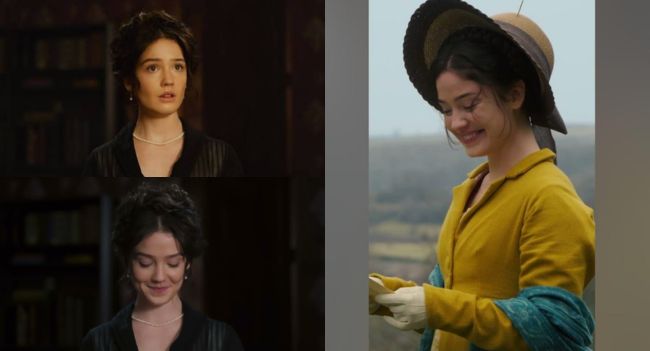
The Power of Quiet Strength: Persephone’s Ultimate Weapon in Taming the “Beast” of Kenswick
In the vast sea of historical romances utilizing the classic “Beauty and the Beast” trope, audiences are easily swept away by the male lead’s explosive rage, tragic scars, or brooding dominance. The cinematic adaptation of Sarah M. Eden’s beloved novel Seeking Persephone is no exception, opening with a heavy darkness enveloping the estate of Adam Cavendish, the Duke of Kenswick. Yet, what truly anchors the audience and serves as the beating heart of the entire story is Persephone Lancaster—a heroine who wields no weapons, yet subdues a monster through a far more formidable power: the art of unyielding calmness and a compassion defined by strict boundaries.

1. Compassion Is Not Blind Submission
Persephone steps into an arranged marriage with a “monster” not as a trembling sacrificial lamb, but as a clear-eyed, deliberate observer. Rather than flinching at Adam’s icy glares or cutting remarks, she consciously chooses to look past his hostile exterior.
From a psychological perspective, Persephone’s patience in the early chapters is neither weakness nor the blind submission typical of the Regency era’s patriarchal expectations; it is a calculated choice. She recognizes that Adam’s cruelty is a classic defense mechanism, born from years of emotional abuse inflicted by his late father. By refusing to meet his aggression with hostility, she shatters the toxic cycle of push-and-pull that Adam relies on to isolate himself, forcing the lonely giant to confront his own deep-seated trauma.
2. The Art of Boundaries: The Power of a Gentle “No”
The most profound element of Persephone’s character is her balance: she knows how to soothe, but she also knows exactly where to draw the line. While she possesses the empathy required to understand Adam’s pain, she holds too much self-respect to ever allow herself to become a punching bag for his unresolved anger.
This is beautifully demonstrated through her steady posture and unwavering gaze during their most intense confrontations. When Adam oversteps the bounds of basic respect, Persephone does not weep or flee; she stands her ground, calmly and fiercely protecting her dignity. In doing so, she teaches Adam a lesson he never received in his youth: that to be loved, one must first learn to respect. This quiet, unshakeable resilience serves as an emotional anchor, preventing their relationship from spiraling into toxicity and forcing Adam to evaluate his behavior to become a man worthy of her presence.
3. A Cinematic Contrast: When Darkness Seeks the Light
Persephone’s quiet strength creates a visually and emotionally stunning contrast on screen. Placed against the massive, brooding silhouette of Adam—a man physically and emotionally scarred, perpetually lurking in the shadows—Persephone emerges as a small but unquenchable light.
The psychological shift between the two characters unfolds with incredible subtlety. Though Adam desperately tries to project an aura of absolute control over her fate, his emotional dependency on her only grows. Dressed in modest, elegant gowns, she stands as the bedrock of sanity in his chaotic world. Persephone does not simply bring springtime to Hades’ underworld; she is spring itself, using her boundless grace and steady inner fortitude to heal and resurrect a soul once thought entirely dead.